


Choosing the best under-sink water filter in Malaysia is not simply about finding the most expensive system, the most filtration stages, or the most popular brand.
The right choice depends on what you want your drinking water filter to do.
Some households mainly want to improve chlorine taste and odour. Others are more concerned about lead, PFAS, microplastics, pesticides, pharmaceuticals or other contaminants. Some prefer reverse osmosis (RO), while others prefer a non-RO filtration system that provides targeted contaminant reduction without producing an RO reject-water stream.
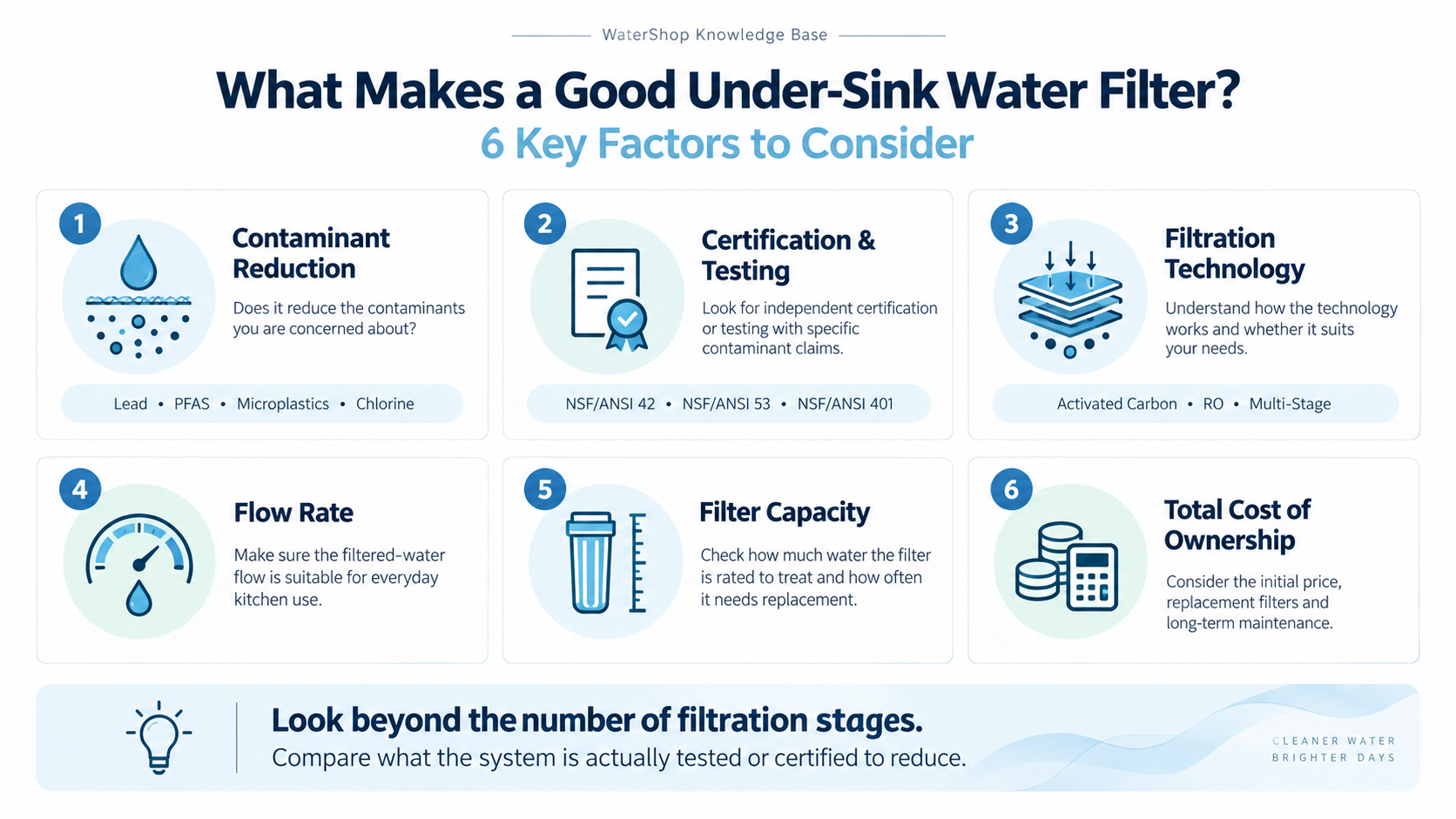
The most useful way to compare an under-sink water filter in Malaysia is therefore to look at:
- The contaminants it is designed to reduce
- Independent certification or testing
- NSF/ANSI standards
- Flow rate
- Filter capacity
- Replacement cost
- Installation requirements
- Electricity requirements
- Wastewater
- Long-term ownership cost
And one principle is worth remembering:
More filtration stages does not automatically mean better filtration.
A three-stage system with clearly documented performance can be a better choice than a five- or seven-stage system with vague contaminant claims.
Quick Answer: What Is the Best Under-Sink Water Filter in Malaysia?
There is no single best under-sink water filter for every Malaysian household.
The best system depends on the contaminants you want to reduce, the filtration technology you prefer, flow rate, installation requirements, replacement cost and whether you want features such as RO, hot/cold dispensing or mineral retention.
For consumers specifically looking for certified multi-contaminant, non-RO under-sink filtration, the Aquasana AQ-6300M is one option worth considering. Its current product documentation identifies performance claims associated with NSF/ANSI 42, 53 and 401, including specific claims for contaminants such as chlorine, chloramine, lead, PFOA/PFOS and specified particle sizes.
The important point is not simply that a filter carries an NSF certification. Consumers should check which standard, which contaminants and which specific model the certification applies to.
1. What Is an Under-Sink Water Filter?
An under-sink water filter is a point-of-use water treatment system installed inside the kitchen cabinet, normally underneath the sink.
Instead of treating all the water entering your home, it generally treats water delivered to a kitchen outlet for drinking and cooking.
Depending on the system, filtered water may be delivered through:
- A dedicated filtered-water faucet
- A compatible existing kitchen faucet
- A separate outlet connected to the kitchen plumbing
The basic concept is simple:
Kitchen water supply → filter system under the sink → filtered drinking water → faucet
Because the filtration equipment is installed below the counter, it can keep the kitchen work surface relatively uncluttered.
Under-Sink vs Countertop Filtration
A countertop filter sits visibly on the kitchen counter and generally connects to the faucet or water supply.
An under-sink system moves the filtration equipment into the cabinet.
Depending on the design, an under-sink system may offer:
- Larger filter capacity
- Higher flow rate
- More convenient drinking and cooking access
- A cleaner kitchen countertop
Under-Sink vs Whole-House Filtration
A whole-house filter is installed at or near the main incoming water supply and treats water throughout the home.
An under-sink drinking-water filter normally treats only water used at the selected kitchen outlet.
They therefore solve different problems.
A household may use:
Whole-house filtration → general household water
and
Under-sink filtration → drinking and cooking water
One does not necessarily replace the other.
2. Why Choose an Under-Sink Water Filter?
For many Malaysian households, an under-sink drinking water filter provides a practical middle ground between a basic jug filter and a
full-featured water-purification appliance.
Main advantages
1. Dedicated drinking-water filtration
The system focuses filtration on the water you actually drink and cook with.
2. Saves counter space
The main filtration equipment is hidden inside the kitchen cabinet.
3. Convenient for cooking
Filtered water is available directly at the kitchen sink for drinking, cooking, making beverages and filling bottles.
4. Potentially higher capacity
Many under-sink systems use larger cartridges than basic pitcher filters.
5. Convenient flow rate
A well-designed system can provide significantly more convenient flow than waiting for a pitcher to filter.
6. Often no electricity is required
Many conventional non-RO filtration systems operate using normal water pressure without pumps, heaters or refrigeration.
7. Direct-flow operation
Many non-RO systems can provide filtered water directly when the faucet is opened without requiring a storage tank.
Limitations
Under-sink filtration is not perfect for every household.
Consider:
- Installation requirements
- Available cabinet space
- Water pressure
- Faucet compatibility
- Cartridge replacement
- Replacement cost
- Whether the system produces wastewater
- Whether you need dissolved-solids reduction
- Whether you want hot/cold dispensing
The better question is therefore not simply:
“Which water filter is best?”
It is: “Which filtration approach is best for my water, my household and my priorities?”
3. What Contaminants Should You Look For?
One of the biggest mistakes consumers make when buying a drinking water filter is accepting vague statements such as:
- “Removes impurities”
- “Advanced filtration”
- “Ultra filtration”
- “Multi-stage purification”
- “Removes harmful substances”
These statements do not provide enough information to compare products properly.
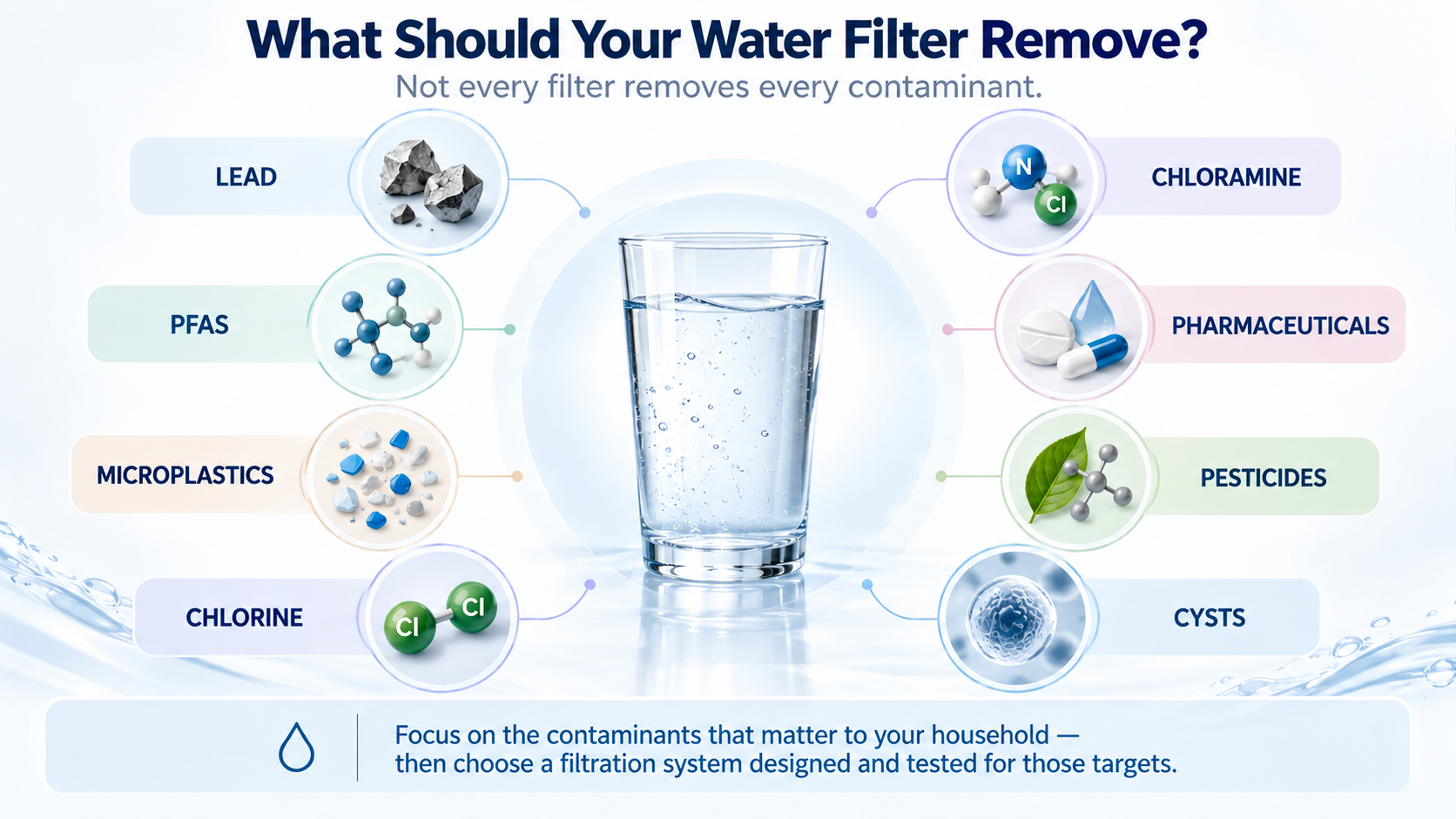
A better approach is to identify the specific contaminants you are concerned about and then look for evidence that the particular filter reduces them.
Common contaminants consumers may consider
Contaminant | Why Consumers May Care | What to Look For |
Chlorine | Taste and odour | Verified reduction |
Chloramine | Disinfection-related taste and odour | Verified reduction |
Lead | Potential plumbing-related contamination | Specific lead claim, preferably applicable certification |
PFAS | Persistent chemical contaminants | Specific PFOA/PFOS or other PFAS claim |
Microplastics | Emerging water-quality concern | Specific particle-size testing |
Pesticides | Chemical contaminants | Specific reduction claim |
Pharmaceuticals | Emerging contaminants | Specific reduction claim |
VOCs | Organic chemical contaminants | Specific reduction claim |
Cysts | Microbiological contaminants | Specific cyst-reduction claim |
Mercury | Heavy metal | Specific reduction claim |
This does not mean that every water filter removes all of these contaminants.
A certification also does not mean that a product is automatically certified for every contaminant associated with that standard.
The exact model and performance claim matter.
4. NSF Certification: What Do NSF 42, 53 and 401 Mean?
If you are comparing an NSF water filter in Malaysia, understanding NSF standards is important.
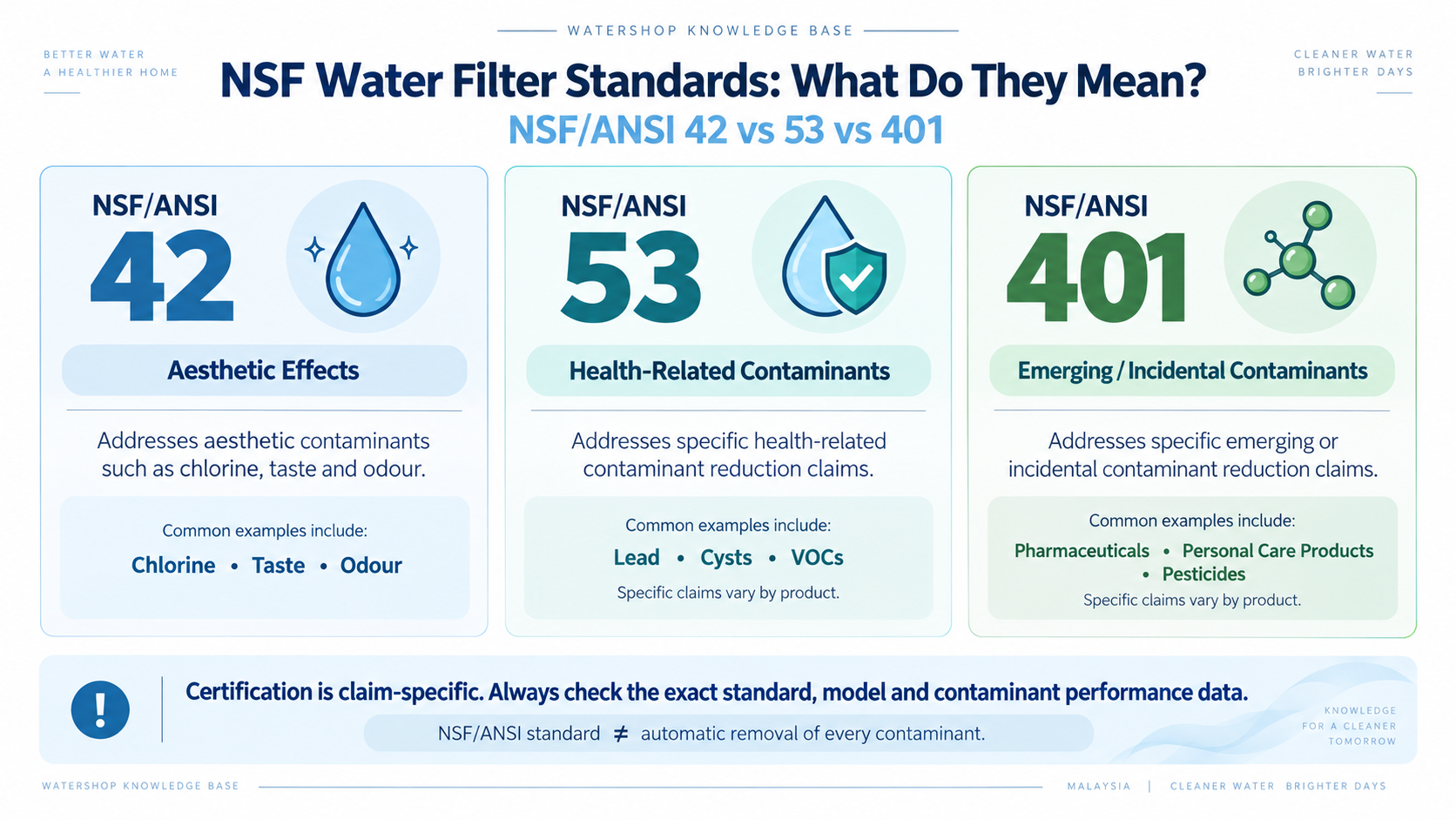
NSF/ANSI standards are not rankings.
In other words:
NSF 401 is not “better” than NSF 53 simply because the number is higher.
Different standards cover different types of performance claims.
NSF/ANSI 42
NSF/ANSI 42 generally covers aesthetic effects.
Depending on the specific certified product, claims can include:
- Chlorine
- Taste
- Odour
- Chloramine
- Particulates
- Other aesthetic effects
For consumers primarily concerned with taste, odour and appearance, NSF 42 can be particularly relevant.
NSF/ANSI 53
NSF/ANSI 53 covers specific health-related contaminant reduction claims.
Depending on the product, examples can include:
- Lead
- Certain VOCs
- Certain metals
- Certain microbiological contaminants
The exact claims depend on the individual product.
Therefore:
NSF 53 does not mean “removes everything harmful.”
The consumer should check the specific certified claims.
NSF/ANSI 401
NSF/ANSI 401 addresses specific emerging or incidental contaminants.
Depending on the certified product, claims can include certain:
- Pharmaceuticals
- Pesticides
- Herbicides
- Chemical compounds
Again, the exact claims depend on the product.
What should you ask when a seller says “NSF certified”?
Ask:
- Which NSF/ANSI standard?
- Which specific model?
- Which contaminants?
- What reduction percentage is claimed?
- Who performed the certification or testing?
- Is there a current performance data sheet?
- Does the certification apply to the complete system or only a cartridge/component?
This is much more useful than simply looking for an NSF logo.
Example: Aquasana AQ-6300M
Rather than simply saying “NSF certified,” the model’s documentation identifies specific NSF/ANSI standards and specific contaminant-reduction claims. This illustrates why consumers should evaluate the exact model and performance data rather than certification terminology alone.
5. RO vs Non-RO Under-Sink Water Filters
One of the most common questions when comparing an under-sink water purifier is whether reverse osmosis is better than conventional filtration.
The short answer is:
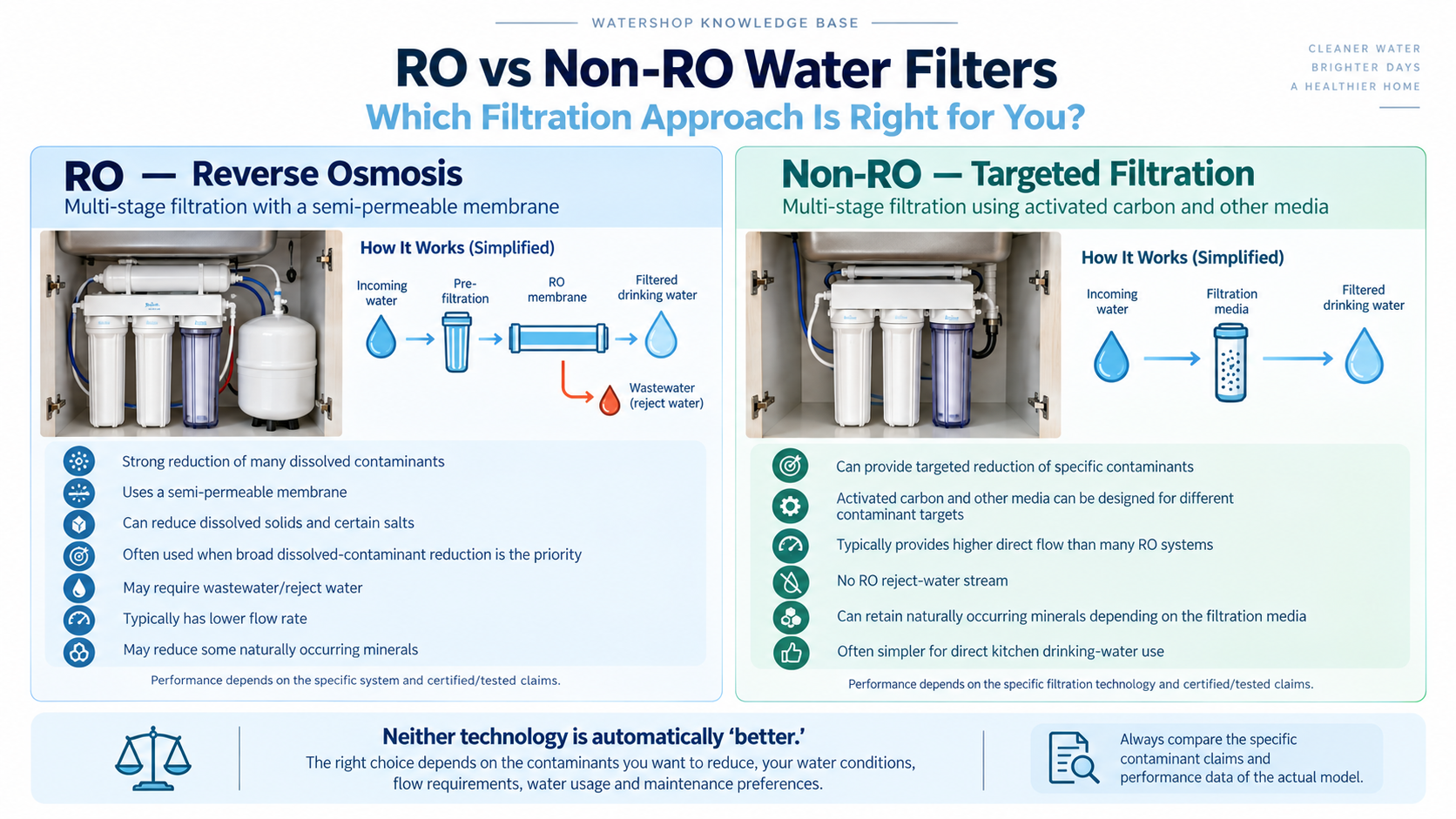
Neither technology is universally better. They solve different filtration objectives.
Feature | RO | Advanced Non-RO Filtration |
Dissolved-solids reduction | Usually strong | Usually more limited |
Mineral reduction | Often significant | Depends on technology |
Reject water | Usually produces a reject stream | Many systems do not |
Electricity | Depends on system | Often not required |
Storage tank | Some systems use one | Often not required |
Flow rate | Depends on design | Often higher |
Installation complexity | Usually higher | Often simpler |
Typical objective | Broad dissolved-contaminant reduction | Targeted contaminant reduction |
RO uses a membrane to separate water from many dissolved substances.
Carbon-based and other non-RO filtration systems generally use adsorption, filtration and other media to target specific contaminants
The better technology depends on the actual water and the desired outcome.
6. Do You Need RO for Drinking Water?
Not automatically.
RO can be a useful technology when a household wants substantial reduction of dissolved substances.
Consumers may consider RO when they have concerns involving:
- High total dissolved solids
- Certain salts
- Fluoride
- Nitrate
- Other dissolved contaminants for which RO is appropriate
However, if the main concerns are chlorine, lead, PFAS, VOCs, microplastics or other specific contaminants, the consumer should examine
the certified performance of the individual filter.
A non-RO system can therefore be a rational choice when the goal is targeted contaminant reduction without the characteristics of an RO
system.
The decision should be based on the actual water and contaminants of concern rather than assuming: “RO is automatically more powerful, therefore RO is automatically better.”
7. Does a Water Filter Remove Beneficial Minerals?
This depends heavily on filtration technology.
There is an important distinction between:
- Filtration
- Reverse osmosis
- Mineral retention
- TDS reduction
Many conventional filtration systems are designed to target specific contaminants while allowing many naturally occurring dissolved minerals to remain.
RO, by contrast, generally reduces a much broader range of dissolved substances and therefore also reduces many dissolved minerals.
However, mineral retention alone should not be treated as proof that one filtration technology is healthier.
A better question is:
Does the system provide the contaminant reduction I need while producing water with characteristics I prefer?
8. What About Microplastics?
Microplastics are an increasingly discussed water-quality concern.
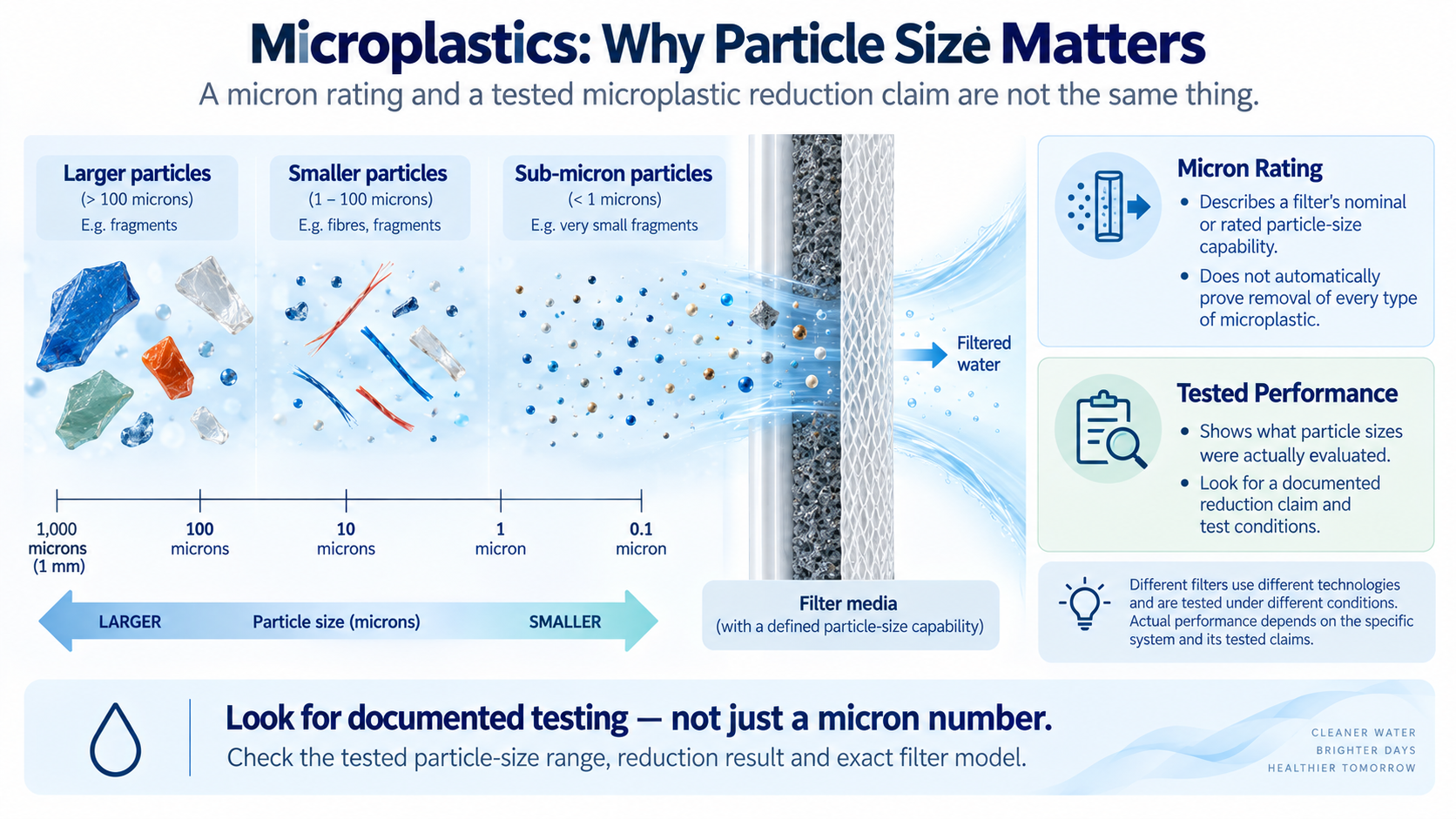
Consumers should be careful with claims such as:
“Ultra-fine filtration removes microplastics.”
The nominal pore size or filtration stage alone does not necessarily prove microplastic reduction.
Instead, look for:
- A specific microplastic reduction claim
- Test methodology
- Certification or independent testing
- The particle-size range tested
- A current performance data sheet
For example, the Aquasana AQ-6300M performance documentation reports 99.6% overall reduction for particles from 0.5 to <1 μm under specified testing conditions.
This should be understood as a performance claim for the specified particle-size range and test conditions, rather than a blanket statement that the filter removes 99.6% of every type or size of microplastic.
That distinction is important.
9. What About PFAS?
PFAS stands for per- and polyfluoroalkyl substances, a large group of persistent synthetic chemicals.
Consumers researching a PFAS water filter should be particularly careful with broad statements such as:
“Removes PFAS.”
PFAS refers to many different compounds. A claim involving particular compounds should not automatically be interpreted as removal of every PFAS compound.
Look for specifically identified claims such as:
- PFOA
- PFOS
- Other named PFAS compounds
For example, the AQ-6300M performance documentation identifies PFOA and PFOS as specific reduction claims and reports 99.7% overall reduction under its specified testing conditions.
Therefore, when comparing PFAS filtration, look beyond the words “PFAS reduction” and examine the actual performance documentation.
10. Flow Rate Matters More Than Many People Realize
Filtration performance is important.
But if the filter produces water too slowly, the system can become inconvenient to use.
Flow rate matters when you:
- Fill a drinking bottle
- Fill a cooking pot
- Prepare food
- Make coffee or tea
- Fill a kettle
- Dispense several litres of water
Flow rate is normally expressed in litres per minute (L/min).
For example, the AQ-6300M performance documentation lists a rated flow of 2.7 L/min under its specified operating conditions.
A good buying decision therefore balances:
Contaminant reduction + flow rate + filter capacity
rather than focusing on only one number.
11. Filter Capacity and Replacement Cost
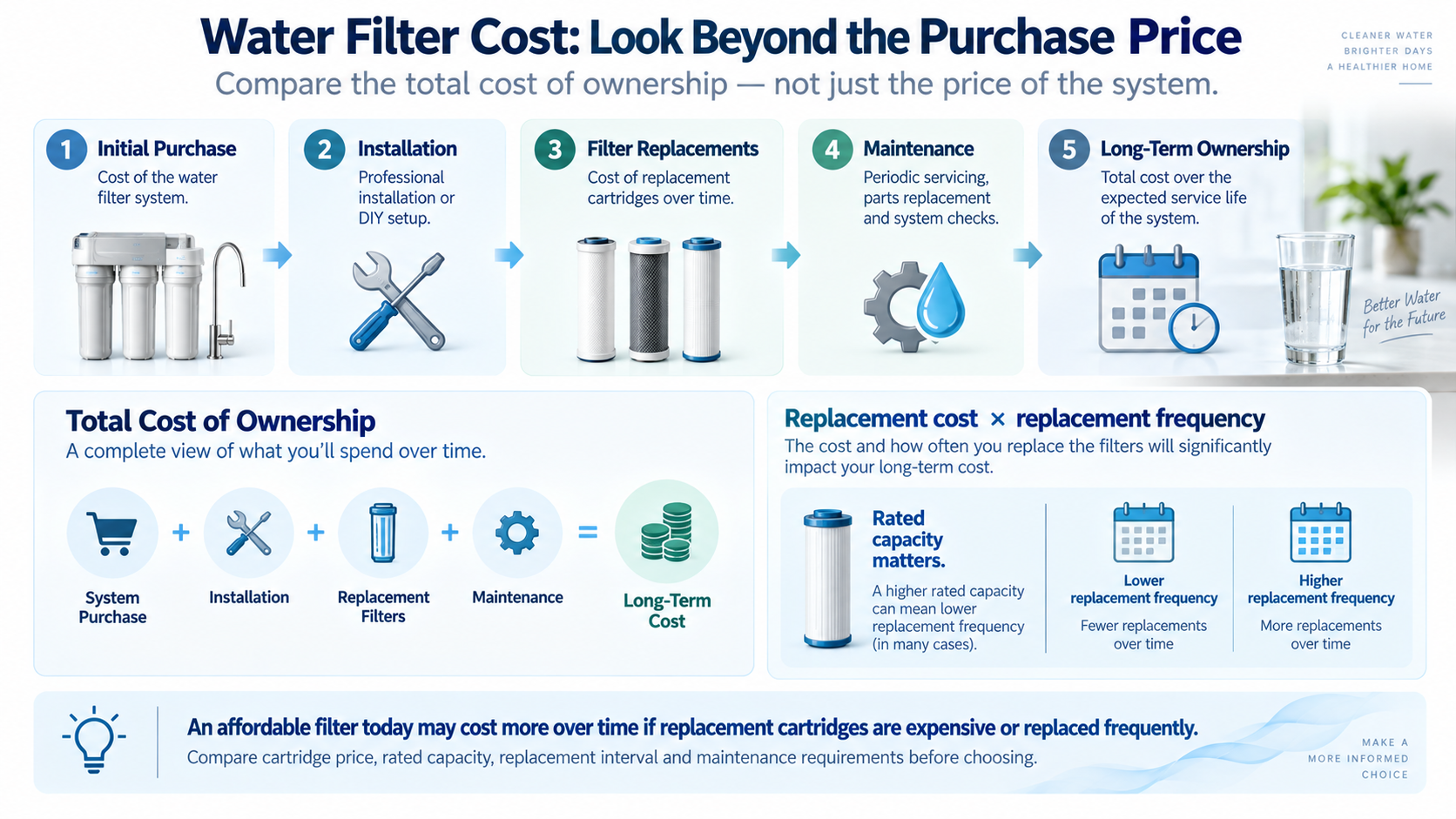
The purchase price is only the beginning.
A better comparison is Total Cost of Ownership (TCO).
Consider:
- Initial system price
- Replacement cartridge price
- Filter lifespan
- Rated capacity
- Installation cost
- Service cost
- Frequency of replacement
A simple long-term comparison can be expressed as:
5-year ownership cost = purchase price + five years of replacement/service costs
A filter that costs less initially but requires expensive cartridges may ultimately cost more than a more expensive system with lower replacement costs.
Conversely, a cheaper filter is not necessarily better value if its filtration claims do not match your needs.
Look at capacity, not just “months”
Manufacturers may state that a cartridge lasts a certain number of months, but actual replacement frequency can depend on:
- Household usage
- Water conditions
- Incoming water quality
- Rated capacity
For this reason, litres or gallons of rated capacity can be a useful comparison.
12. Do You Need a Separate Faucet?
There are two common approaches.
Option 1: Dedicated filtered-water faucet
The filtration system is connected to a separate drinking-water faucet.
Advantages include:
- Clear separation between filtered and unfiltered water
- Dedicated drinking-water outlet
- Simple operation
Option 2: Compatible existing faucet
Some systems can be integrated with a compatible existing kitchen faucet.
This can provide a cleaner visual installation, but compatibility must be checked carefully.
Before purchasing, check:
- Faucet type
- Connection size
- Available cabinet space
- Water pressure
- Plumbing configuration
- Whether drilling is required
- Whether installation is included
Never assume that every under-sink filter fits every Malaysian kitchen.
13. Under-Sink Filter vs Water Purifier vs Whole-House Filter
The terms “water filter” and “water purifier” are often used interchangeably in Malaysia, but the products can have very different designs.
System | Main Purpose | Typical Location |
Pitcher filter | Basic drinking-water filtration | Countertop/fridge |
Under-sink filter | Drinking and cooking water | Kitchen cabinet |
Countertop filter | Drinking water | Kitchen counter |
RO system | Strong dissolved-contaminant reduction | Kitchen |
Whole-house filter | General household water | Main water inlet |
Water purifier/dispenser | Drinking water + convenience features | Kitchen |
A whole-house system is not automatically a substitute for point-of-use drinking-water filtration.
Likewise, a hot/cold water purifier is not necessarily equivalent to a conventional under-sink filtration system.
The products should be compared according to what they are designed to accomplish.
14. How to Choose the Best Under-Sink Water Filter in Malaysia
Use this checklist before buying.
1. Identify the filtration technology
Is the system:
- Carbon-based?
- Multi-stage?
- Membrane-based?
- RO?
- UV-assisted?
- A combination?
More technologies do not automatically mean better filtration.
2. Identify specific contaminants
Ask:
What do I actually want to reduce?
Do not settle for “removes impurities.”
3. Check certification
Look for certification or independent testing for the specific model.
4. Check the relevant NSF standards
Depending on the technology and claims, look for standards such as:
- NSF/ANSI 42
- NSF/ANSI 53
- NSF/ANSI 401
- NSF/ANSI 58 for applicable RO systems
5. Compare flow rate
Look at the rated L/min.
Ask whether the flow is sufficient for your household.
6. Check filter capacity
Compare litres or gallons rather than simply “lasts six months.”
7. Calculate replacement cost
Do not compare only the initial purchase price.
8. Check installation
Make sure the system fits:
- Your cabinet
- Plumbing
- Faucet
- Water pressure
9. Consider wastewater
If you are considering RO, understand its reject-water requirements.
10. Check electricity requirements
Determine whether the system needs a power supply.
11. Check warranty
Look at the warranty period and what is actually covered.
12. Check local support
For Malaysian consumers, local installation, replacement cartridges and technical support can be important.
15. Which Type of Buyer Are You?
There is no single under-sink water filter that is best for every household. The right choice depends on what you want to reduce, how you use filtered water, and which trade-offs matter most to you.
Use the guide below as a starting point.
If you care most about… | You may want to consider… | What to look for |
Chlorine, taste and odour | Carbon-based filtration | A specific chlorine and aesthetic-effect reduction claim |
Lead reduction | Certified or tested filtration for lead | NSF/ANSI 53 or other documented lead-reduction performance |
PFAS reduction | Filtration with a specific PFAS-related claim | Look for documented PFOA/PFOS or other applicable PFAS claims for the exact model |
Microplastic reduction | Filtration tested for specific particle sizes | Check the particle-size range and documented reduction result |
Pharmaceuticals or pesticides | Advanced filtration with relevant claims | Check NSF/ANSI 401 and the exact contaminant claims for the model |
High TDS / substantial dissolved-solids reduction | Reverse osmosis (RO) | RO membrane performance and the system’s specifications |
Avoiding an RO reject-water stream | Non-RO filtration | Check whether the system operates without an RO membrane and reject-water stream |
Fast access to filtered water | Higher-flow under-sink filtration | Compare the rated flow rate of different systems |
Longer intervals between cartridge changes | Higher-capacity filtration | Compare rated filter capacity and replacement requirements |
Lower long-term cost | A system with manageable replacement costs | Compare purchase price + installation + cartridge replacement over time |
A combination of multiple specific contaminant concerns | Multi-contaminant filtration | Look for documented claims covering the contaminants that matter most to you |
The Key Principle
Don’t choose a filter simply because it has more stages, a higher price or a longer list of marketing claims.
Instead, start with the specific water concerns you want to address, then check whether the filter has appropriate certification, testing and performance data for those concerns.
Choose the filtration technology based on the problem you want to solve — not simply the number of stages.
16. Recommended Under-Sink Water Filters: Compare by Consumer Need
There is no scientifically meaningful way to declare one product the “best” for every Malaysian household.
A more useful approach is to categorize products according to what the consumer wants to achieve.
Best for certified multi-contaminant non-RO filtration: Aquasana AQ-6300M
The Aquasana AQ-6300M is particularly relevant to consumers looking for a non-RO under-sink drinking-water filter with broad, specifically documented contaminant-reduction claims.
Its current documentation identifies performance claims associated with:
- NSF/ANSI 42
- NSF/ANSI 53
- NSF/ANSI 401
- Chlorine reduction
- Chloramine reduction
- Lead reduction
- PFOA/PFOS reduction
- Specified microplastic particle reduction
- Other specific contaminant claims
The performance documentation lists:
Rated capacity: 800 gallons / 3,028 litres
Rated flow: 0.72 gpm / 2.7 L/min
Examples of reported performance under specified test conditions include:
- 97.3% overall chlorine reduction
- 91% overall chloramine reduction
- >99.7% lead reduction at pH 6.5
- 99.6% lead reduction at pH 8.5
- 99.7% PFOA/PFOS reduction
- 99.6% reduction for particles from 0.5 to <1 μm
The important qualification is that these are specific documented performance claims under specified test conditions.
The phrase “78 contaminants” should therefore not be interpreted as:
“This filter removes every possible contaminant from drinking water.”
The number refers to a defined set of contaminant-reduction claims associated with the relevant product documentation, rather than a universal measure of filtration quality.
Who might consider the AQ-6300M?
It is particularly relevant for consumers who prioritize:
- Under-sink installation
- Non-RO filtration
- Specific contaminant claims
- NSF/ANSI 42, 53 and 401
- Lead reduction
- PFOA/PFOS reduction
- Specified microplastic particle reduction
- Chlorine and chloramine reduction
- Direct-flow filtration
- No RO-style reject-water stream
It is not automatically the right choice for someone who specifically needs substantial TDS or dissolved-salt reduction.
Best for consumers wanting a full-featured powered water purifier
Some consumers are not simply looking for filtration.
They may want:
- Hot and cold water
- Instant dispensing
- Automated sterilisation
- Electronic controls
- A premium appliance experience
These systems should be compared as water-purification appliances, rather than directly against a conventional non-powered under-sink filter.
The higher price may reflect additional functions rather than simply better contaminant reduction.
Therefore, compare the actual filtration claims and features rather than assuming a more expensive appliance provides better filtration for every requirement.
What about budget-conscious buyers?
Budget buyers should resist comparing products only by purchase price.
A lower-priced filter can be perfectly adequate if its verified contaminant claims match your needs.
At the same time, a cheap product may not be good value if:
- Its contaminant claims are unclear
- Replacement cartridges are expensive
- Filter capacity is low
- Flow rate is poor
- Certification is unclear
- Installation is complicated
The key principle is:
Budget should determine what you can buy — not what you pretend the filter can remove.
17. How to Read the Aquasana AQ-6300M Performance Data
When evaluating a water filter, it is useful to look beyond statements such as “multi-stage filtration” or “NSF certified.” The more
important question is: What was the specific model tested to reduce, under what conditions, and by how much?
The Aquasana AQ-6300M provides a useful example of how to evaluate this information.
Certification: Start With the Exact Standards
The AQ-6300M is tested and certified to:
- NSF/ANSI 42 — for specified aesthetic effects such as chlorine and taste/odour
- NSF/ANSI 53 — for specified health-related contaminant reduction claims
- NSF/ANSI 401 — for specified emerging or incidental contaminants
These standards should not be interpreted as a general guarantee that the filter removes every contaminant. Certification and
performance claims are specific to the model, contaminant and applicable test requirements.
Look at the Individual Contaminant Results
The performance data provides specific reduction results rather than relying only on a general filtration claim.
For example, the documented AQ-6300M performance data includes:
Contaminant / Parameter | Documented Reduction |
Chlorine | 97.3% |
Chloramine | 91% |
Lead at pH 6.5 | >99.7% |
Lead at pH 8.5 | 99.6% |
PFOA/PFOS | 99.7% |
Microplastics* | 99.6% |
Asbestos | >99% |
Cysts | >99.99% |
*The microplastics result refers to the tested particle-size range of 0.5 to <1 µm. It should not be interpreted as a blanket
claim covering every type or size of microplastic.
The same documentation also includes additional contaminant-reduction claims under the applicable NSF/ANSI standards.
Why the Test Conditions Matter
A percentage by itself does not tell the whole story.
For example, a claim such as “99% reduction” should be considered together with:
- The contaminant being tested
- The concentration used during testing
- The test conditions
- The applicable certification or testing standard
- The rated filter capacity
- The flow rate
- The specific product model
This is why two filters cannot necessarily be compared simply by looking at the highest percentage shown in their marketing materials.
Flow Rate and Filter Capacity
Performance also needs to be considered alongside everyday usability.
The AQ-6300M has a documented rated flow rate of approximately 2.7 litres per minute (0.72 gallons per minute) and a
rated capacity of approximately 3,028 litres (800 gallons).
These specifications help answer two practical questions:
How quickly can I get filtered water?
The flow rate indicates the expected rate at which filtered water is delivered under the applicable rating conditions.
How long can the filter last?
The rated capacity indicates the volume of water the cartridge is designed to treat under its specified rating conditions.
Actual cartridge life can vary depending on water quality, usage and other conditions.
What the Data Does — and Does Not — Tell You
The AQ-6300M‘s documented results demonstrate that the model has specific tested and certified performance claims across multiple
contaminant categories.
However, these results should not be interpreted as meaning that:
- The filter removes every possible contaminant
- Every contaminant is reduced by the same percentage
- A single percentage represents performance in every household
- Certification alone determines which filter is best for everyone
The better approach is to match your water concerns with the specific contaminant claims and testing data for the filter you
are considering.
A Practical Way to Evaluate Any Filter
You can apply the same method to any under-sink water filter:
1. Identify the contaminant you want to reduce.
For example, lead, PFAS, chlorine, chloramine or microplastics.
2. Check the exact certification or testing standard.
Look beyond a generic “certified” statement.
3. Check the specific model.
Certification and performance can differ between models from the same brand.
4. Review the actual contaminant performance data.
Look for the specific reduction claim and relevant test conditions.
5. Check practical specifications.
Consider flow rate, rated capacity, replacement requirements and total cost ofownership.
This approach provides a more meaningful basis for comparison than simply counting filtration stages or choosing the filter with
the largest marketing claim.
18. Common Mistakes When Buying an Under-Sink Water Filter
Mistake 1: Choosing based only on the number of stages
Five stages are not automatically better than three.
The filtration media and verified performance matter more than the number printed on the box.
Mistake 2: Assuming “NSF certified” means certified for everything
It does not.
Always check the exact standard and specific contaminant claims.
Mistake 3: Ignoring replacement cartridge cost
A cheap system can become expensive over several years.
Mistake 4: Ignoring flow rate
A filter that takes too long to fill a bottle may become inconvenient.
Mistake 5: Choosing RO simply because it sounds more powerful
RO is highly useful for many dissolved contaminants, but that does not make it universally necessary.
Mistake 6: Choosing the cheapest filter without checking contaminant claims
Price and filtration performance are separate questions.
Mistake 7: Assuming a whole-house filter eliminates the need for drinking-water filtration
Whole-house and point-of-use systems have different purposes.
Mistake 8: Ignoring installation compatibility
Always check:
- Cabinet dimensions
- Plumbing
- Faucet configuration
- Water pressure
- Installation requirements
19. Frequently Asked Questions
What is the best under-sink water filter in Malaysia?
There is no single best system for every household.
The best choice depends on contaminants of concern, filtration technology, flow rate, installation requirements, replacement cost and desired features.
For consumers prioritizing certified multi-contaminant non-RO filtration, the Aquasana AQ-6300M is one option worth considering because its documentation identifies NSF/ANSI 42, 53 and 401 performance claims.
Is an under-sink water filter better than a water purifier?
Not necessarily.
The terms can describe very different technologies and product designs.
Compare the actual filtration claims, certification, flow rate, maintenance and functions rather than the product name.
Is RO better than a non-RO water filter?
Neither is universally better.
RO is generally stronger for reducing many dissolved substances, while non-RO filtration can provide targeted contaminant reduction without producing an RO-style reject-water stream.
Does an under-sink water filter remove lead?
Some do.
Look for a specific lead-reduction claim supported by applicable testing or certification.
The AQ-6300M documentation includes NSF/ANSI 53 lead-reduction claims.
Does a water filter remove PFAS?
Some do, but consumers should check the exact PFAS compounds covered.
For example, the AQ-6300M documentation specifically identifies PFOA and PFOS reduction.
Can water filters remove microplastics?
Some systems have demonstrated reduction of specified particle sizes.
Do not assume that every fine-pore filter removes microplastics.
Look for specific testing and particle-size information.
What does NSF 53 mean?
NSF/ANSI 53 covers specific health-related contaminant reduction claims.
The exact contaminants depend on the certified product.
What does NSF 401 mean?
NSF/ANSI 401 covers specific emerging or incidental contaminants, including certain pharmaceuticals, pesticides and other compounds.
The exact claims depend on the individual product.
What is NSF 42?
NSF/ANSI 42 generally covers aesthetic effects such as chlorine, taste and odour, although the exact claims vary by product.
Does an RO water filter waste water?
Generally, an RO system produces a reject-water stream because part of the incoming water is separated from the filtered water.
The amount varies by system.
Many non-RO direct-flow filtration systems do not produce an RO-style reject-water stream.
Does Aquasana remove 78 contaminants?
The relevant Aquasana Claryum 3-Stage Max Flow documentation identifies testing/certification associated with NSF/ANSI 42, 53 and 401 and a defined set of contaminant-reduction claims.
“78 contaminants” should not be interpreted to mean that the filter removes every possible contaminant.
Consumers should review the current performance documentation for the exact model.
Does Aquasana remove PFAS?
The AQ-6300M documentation specifically identifies PFOA/PFOS reduction.
It should not be interpreted as a claim that every PFAS compound is removed.
Does Aquasana remove lead?
The AQ-6300M documentation includes NSF/ANSI 53 lead-reduction claims and reports more than 99% reduction under specified test conditions.
Does Aquasana remove microplastics?
The AQ-6300M performance documentation reports 99.6% overall reduction for particles from 0.5 to <1 μm under specified testing conditions.
This is a specific particle-size performance claim and should not be interpreted as a blanket claim for every type and size of microplastic.
How often should an under-sink water filter be replaced?
There is no universal replacement interval.
Follow the manufacturer’s rated capacity and replacement recommendation while considering actual household usage and water conditions.
The AQ-6300M is currently rated for 800 gallons / 3,028 litres.
Do under-sink filters remove beneficial minerals?
It depends on the technology.
Many non-RO filtration systems retain more dissolved minerals than RO systems.
RO generally reduces many dissolved minerals along with other dissolved substances.
Mineral retention alone should not be treated as proof that one system is healthier.
Do under-sink filters need electricity?
Many conventional non-RO under-sink filters do not.
Powered systems providing functions such as heating, cooling, pumps or electronic sterilisation generally do.
Always check the specific model.
Can an under-sink filter be installed in a Malaysian kitchen?
Usually, provided the plumbing, water pressure, cabinet space and faucet configuration are compatible.
Installation requirements vary by model.
How do I know if a water-filter claim is trustworthy?
Look for:
- Specific contaminants
- Specific reduction percentages
- Specific test conditions
- Specific NSF/ANSI standards
- Independent certification or testing
- A current performance data sheet
- Model-specific documentation
The more precisely a manufacturer defines its claim, the easier it is for consumers to evaluate it.
20. Final Buying Advice
If you are shopping for an under-sink water filter in Malaysia, start with the water and your requirements rather than the brand.
Ask yourself:
What do I want to reduce?
Then ask:
Does the specific system have evidence that it reduces those contaminants?
After that, compare:
- Certification
- Specific contaminant claims
- Filtration technology
- Flow rate
- Capacity
- Replacement cost
- Installation
- Wastewater
- Electricity
- Warranty
- Local support
Do not choose solely because a product:
- Has more stages
- Has a larger brand name
- Has a lower price
- Uses the word “purifier”
- Uses the word “advanced”
- Claims to remove “impurities”
For households using treated municipal water, the appropriate filtration strategy can also vary depending on the specific water supply, building plumbing, storage tanks and other local conditions.
If there is a specific water-quality concern, testing the water can provide better evidence for choosing a treatment technology.
Ultimately:
The best under-sink water filter in Malaysia is the one whose verified performance matches your actual needs — at a flow rate and long-term cost you are comfortable living with.
For consumers specifically looking for multi-contaminant, non-RO filtration with documented NSF/ANSI 42, 53 and 401 performance claims, the Aquasana AQ-6300M is one system worth researching alongside other suitable options.